
Agentic AI vs. AI Agents: What's the Actual Difference?
Agentic AI and AI agents are related, but they are not the same thing. An AI agent handles one task; agentic AI coordinates agents, tools, and data toward a larger goal.
Agentic AI vs. AI Agents: What's the Actual Difference?
Last updated July 2026
Quick answer: an AI agent is a single component that handles one task. Agentic AI is the broader system, the orchestration layer that coordinates multiple agents, tools, data sources, and agent skills toward a goal that spans more than one step.
The confusion is understandable. Vendors use "agent", "agentic", and "AI workflow" as if they were the same thing because the words are useful on a landing page. But the difference matters when you are deciding what to build, what to buy, and what risk you are actually accepting.
What is an AI agent?
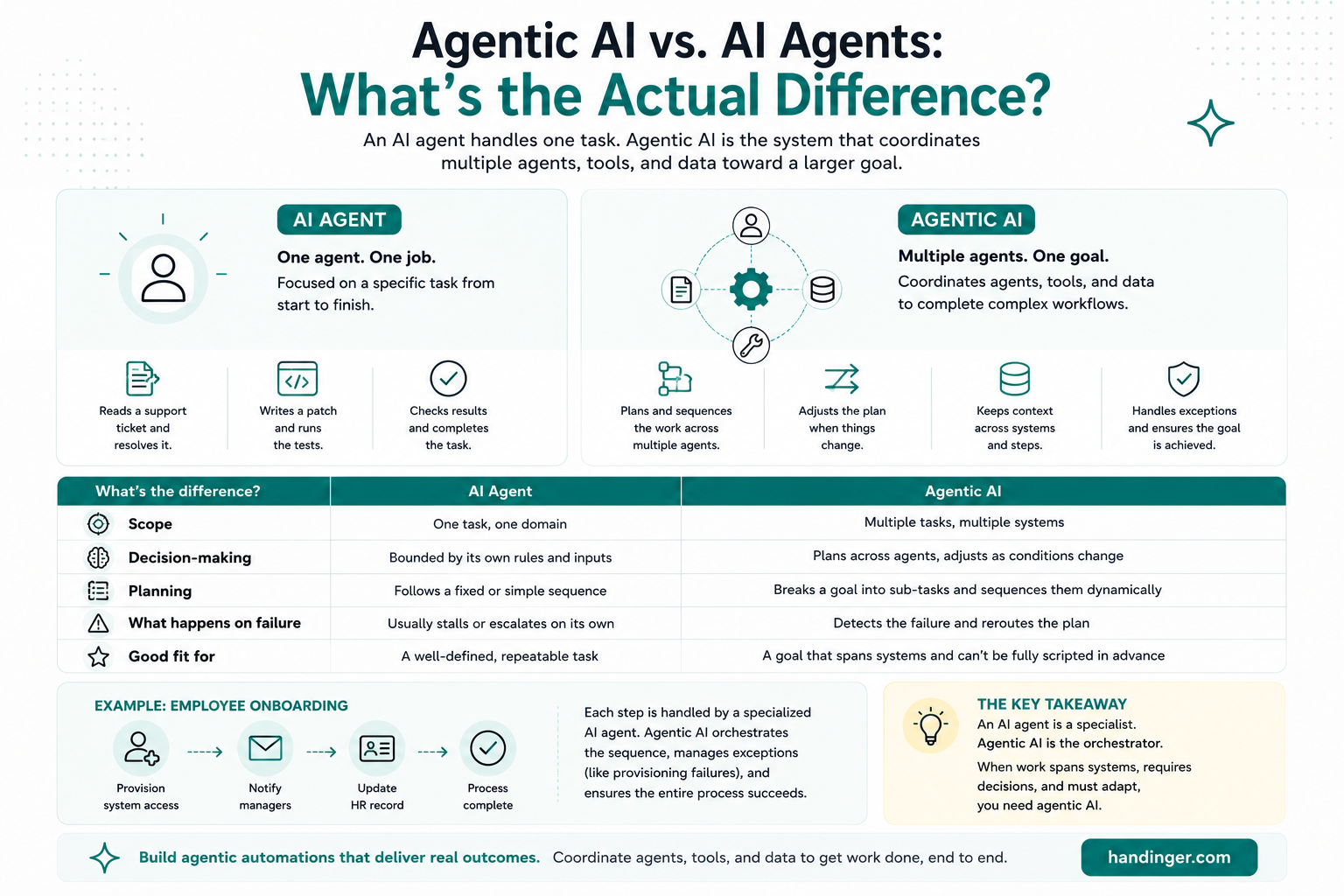
An AI agent is software that understands a goal, plans the steps, uses tools, and checks the result. One agent, one job. It reads a support ticket and resolves it. It writes a patch and runs the tests. It researches a lead and updates a CRM record.
That does not make it simple. A good agent still needs permissions, tool access, context, logs, and guardrails. But its scope is bounded. It owns one slice of work.
What is agentic AI?
Agentic AI is what you get when a system coordinates multiple agents, tools, and data sources toward a larger outcome. It decides which agent handles which part, in what order, and what should happen when conditions change halfway through.
Take employee onboarding. One agent provisions system access. Another notifies managers. A third updates the HR record. Each agent has a narrow job. Agentic AI is the layer above them that sequences the work, handles exceptions, and makes sure the whole process actually completes.
The practical difference
An AI agent completes a task. Agentic AI runs the workflow toward an outcome.
| What's different? | AI Agent | Agentic AI |
|---|---|---|
| Scope | One task, one domain | Multiple tasks, multiple systems |
| Decision-making | Bounded by its own rules and inputs | Plans across agents and adapts as conditions change |
| Planning | Follows a fixed or simple sequence | Breaks a goal into sub-tasks and sequences them dynamically |
| Failure handling | Usually stalls or escalates on its own | Detects failure and reroutes the plan |
| Good fit for | A well-defined, repeatable task | A goal that spans systems and cannot be fully scripted in advance |
You can have five agents running side by side and still not have agentic AI. The dividing line is coordination. If nothing is planning across those agents, choosing the next step, and preserving context between systems, you have parallel automation, not an agentic system.
Where does this get risky?
The autonomy that makes agentic AI useful is also what makes it sensitive. A system that coordinates work across tools often has broad credentials, access to private data, and enough freedom to make decisions before a human sees them.
Two risks deserve special attention. The first is agent hijacking: if an attacker compromises the agentic system, they may gain an autonomous actor inside several connected systems at once. The second is prompt injection, where malicious instructions hidden inside a document, webpage, or email are treated as if they were legitimate task instructions.
The answer is not to avoid agentic AI. It is to add human checkpoints for irreversible actions, narrow permissions, strong logs, and clear stop conditions. The blast radius is bigger than with a single agent, so the controls need to be stronger too.
How do skills fit into agentic AI?
If agentic AI is the orchestration layer and AI agents are the workers, agent skills are how each worker becomes good at its part of the job.
A provisioning agent might carry a skill that explains your access policy. A sales research agent might carry a skill for qualifying accounts. A support agent might carry a skill for refund rules. The orchestrator should not encode all that specialist knowledge itself. It should choose the right agent and let that agent use the right skill.
Well-built agentic systems usually need both: coordination at the top, and specialist skills inside the individual agents.
Common misconceptions
"Agentic AI is just a rebrand of AI agents." Sometimes vendors use it that way, but the architectural distinction is real. Agentic AI is about orchestration and replanning, not just one autonomous component.
"More agents automatically means agentic." No. More agents only means more agents. The system becomes agentic when something coordinates them toward a shared outcome.
"You need agentic AI for every serious task." Also no. If the job is narrow and repeatable, a single agent is usually cheaper, faster, and easier to trust.
Common questions
What does agentic AI mean? Agentic AI means a system that can plan, sequence, and coordinate actions across agents or tools toward a goal, adjusting the plan when conditions change.
Is agentic AI the same as generative AI? No. Generative AI creates content. Agentic AI uses models, tools, memory, and planning to act toward an outcome.
Do I need agentic AI or a single AI agent? Use a single agent when the task stays inside one clear lane. Use agentic AI when the workflow spans systems, requires sequencing, and needs to adapt as it runs.
Can agent skills replace agentic AI? No. Skills make individual agents more capable. Agentic AI coordinates agents and tools. They solve different parts of the problem.
Where is this going?
"Agentic AI" is still doing double duty: part genuine architecture, part marketing shorthand. The useful question is simpler than the terminology. Does the task stay in one lane, or does it need to plan, adapt, and coordinate across more than one system?
That answer tells you what you are actually building.
Related posts
What Are AI Agent Skills? A Practitioner's Guide
Last updated July 2026 Quick answer: an agent skill is a portable, on-demand instruction package, usually a markdown file plus optional scripts and templates, that an AI agent...
What Is an AI Agent? A Practitioner's Plain-English Definition
Last updated July 2026 Quick answer: an AI agent is software that perceives a goal, plans how to reach it, and takes action on its own using real tools instead of just guessing....
Where to read AI agents news
In 2024, most of us were still arguing about whether chatbots could write a decent email, and just two years later, my grandma is publishing iOS apps with the help of AI agents....