
What Is an AI Agent? A Practitioner's Plain-English Definition
An AI agent is software that plans and acts toward a goal on its own. Here's what that means, how they work, the types, and where they actually break, from someone who builds them.
What Is an AI Agent? A Practitioner's Plain-English Definition
Last updated July 2026
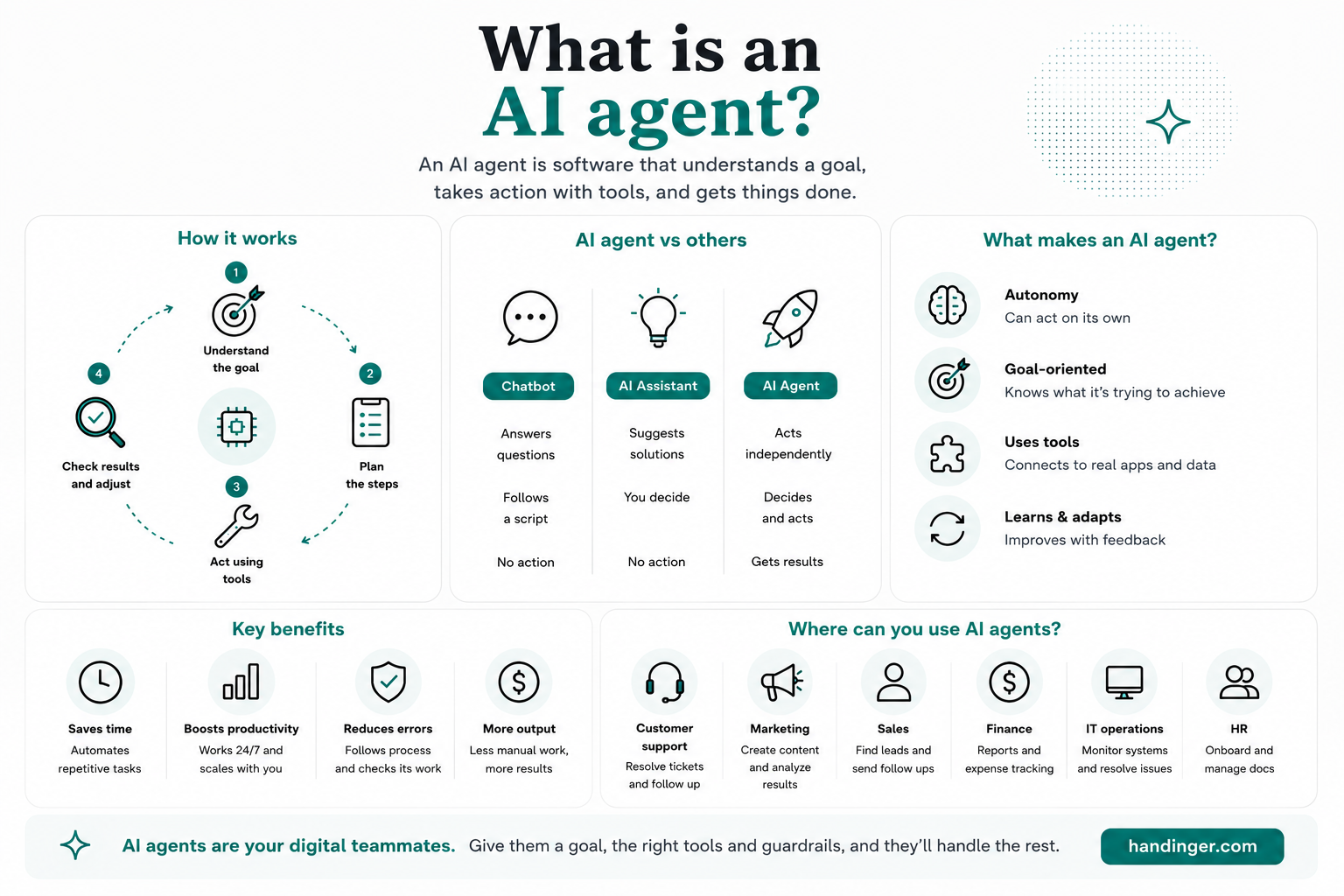
Quick answer: an AI agent is software that perceives a goal, plans how to reach it, and takes action on its own using real tools instead of just guessing. Then it checks its own results and adjusts. That's different from a chatbot, which only responds, or an AI assistant, which suggests but leaves the decision to you. When agents need repeatable specialist workflows, those workflows are often packaged as AI agent skills.
If you are comparing one agent with a coordinated multi-agent system, read the deeper breakdown of agentic AI vs. AI agents.
Everyone throws the term "AI agent" around right now like it means one specific thing. It doesn't. I've built agents that were genuinely useful, and I've built one that quietly burned through $40 in API calls overnight because it got stuck asking itself the same question in a loop. Both were technically "AI agents." So let's actually pin this down.
What is an AI agent, exactly?
An AI agent is software that can look at a goal, figure out the steps needed to get there, and take action on its own, without you telling it exactly what to click or type at every stage. That's the core of it. Not a chatbot that answers questions. Not a script that runs on a schedule. Something that decides, plans, and acts, then checks its own work along the way.
Strip away the vendor marketing and the definition holds up across every major write-up on the topic, from McKinsey to IBM to AWS. An AI agent perceives its environment, reasons about what it's seeing, and takes action toward a goal, usually using a large language model as the reasoning engine and a set of tools to actually do things in the world.
The tools part matters more than people give it credit for. A model on its own can only generate text. Give it a tool, say, the ability to actually query your database instead of guessing what's in it, and suddenly it can affect something outside the chat window. That's the line between a smart autocomplete and an agent.
I'd put it plainer than most of the corporate explainers do. An agent is a loop: perceive, decide, act, check, repeat. That loop is the whole idea. Memory and coordination with other agents get bolted on later to make it more useful in specific situations, but the loop itself is what makes something an agent in the first place.
What's the difference between an AI agent, an AI assistant, and a chatbot?
The short version: a chatbot won't deviate from its script. An assistant will suggest something but leaves the call to you. An agent just goes and does it, then checks its own work.
| Chatbot | AI assistant | AI agent | |
|---|---|---|---|
| Autonomy | None. Follows fixed scripts | Low. Responds to your requests | High. Acts independently toward a goal |
| Who decides? | The rules, set in advance | You decide, it suggests | It decides, then reports back |
| Typical example | An FAQ bot answering "what are your hours?" | Drafting an email for you to send | Drafting and sending the email, then confirming it landed |
I get asked constantly whether ChatGPT is an AI agent. Short answer: not really, not by itself. It's an extraordinarily capable text generator, but it doesn't independently decide to check your calendar and reschedule a meeting unless you've wired that capability in. Give it tool access and permission to act without checking in at every step, and it starts behaving like an agent.
Treat this as a spectrum rather than three separate boxes. In practice, most products today sit somewhere in the middle, and companies stretch the word "agent" to cover whatever they're selling. One place I've found the distinction genuinely useful: when a client asks for an "agent" for their support inbox, I ask them one question. Do you want this to draft a reply for a human to send, or do you want it sending replies on its own? The first is an assistant. The second is an agent. Completely different build, completely different risk profile.
How do AI agents work?
Underneath the buzzwords, most agents run through the same four-stage loop.
Get a goal. Someone, a user or another system, hands it an objective in plain language. "Find me the cheapest flight to Lisbon in October that doesn't have a layover longer than two hours."
Plan the steps. Bigger goals get broken into smaller ones. Agent frameworks tend to differ here. Some plan the entire sequence upfront (the ReWOO approach, reasoning without observation), while others plan one step, act, look at what happened, then plan the next step based on that (ReAct, short for reasoning and acting). ReAct tends to be more adaptable but slower and more expensive, since it's constantly re-thinking. ReWOO is faster and cheaper but brittle if the first plan turns out to be wrong.
Act using tools. This is where tools come in, an API call to the flight search service, in this case. The agent isn't guessing at flight prices from its training data. It's pulling live numbers.
Check and adjust. Did the action produce something useful? Does the plan need to change? Good agents loop back here rather than declaring victory after step one. This is also exactly where things go wrong if you don't build in limits. An agent that keeps "checking" without a stop condition will happily run for hours, calling the same API over and over, which is precisely the mistake I made early on. I'd forgotten to cap the number of retries on a research agent, and it kept re-querying a search tool because the results technically didn't satisfy its own success criteria. I woke up to a very unpleasant API bill.
Memory ties the loop together over time. Short-term memory holds the current conversation or task. Long-term memory, usually a vector database in practice, lets the agent remember what happened last time and actually learn from it. Without memory, every task starts from zero. Fine for a one-off, useless for anything meant to improve over repeated use.
What are the types of AI agents?
Not every agent needs the full loop described above. Here's the progression, from simplest to most capable:
- Simple reflex agents just match a condition to an action: if this keyword appears, do that thing. No memory, no planning involved. Fine for something like auto-replying to a password reset request. Overkill to build anything fancier for that job.
- Model-based reflex agents keep a running internal picture of their environment, so they can handle situations that are only partially visible at any one moment. A robot vacuum remembering which rooms it already cleaned is the classic example.
- Goal-based agents plan out a sequence of actions to reach a specific outcome, comparing different paths before committing. A route-planning system deciding between three possible roads is doing this.
- Utility-based agents go a step further and weigh trade-offs, is it faster or is it cheaper, picking whichever option wins on balance rather than just the one that technically works.
- Learning agents adapt their own behavior based on feedback over time. This is the category most people actually mean when they say "AI agent" today, since almost everything built on top of an LLM has some capacity to improve from interaction data or fine-tuning.
- Multi-agent systems split a job across specialists instead of relying on one generalist agent to do everything. Picture three agents on the same task: one pulls the data, one drafts from it, one checks the draft before anything ships.
I've had noticeably better results running that kind of "critic" agent, one whose only job is reviewing another agent's output before anything gets sent to a user. It catches a surprising number of errors a single-pass agent would miss, though it's slower and costs more tokens. You're trading latency and spend for accuracy.
What is agentic AI, and how is it different from an AI agent?
An AI agent is one system doing one job. Agentic AI is the broader term for the approach: several agents coordinating, or a single agent operating with a high degree of independence over an extended task. MIT Sloan professor Sinan Aral draws that distinction explicitly, and it's a useful one even if most people, myself included in casual conversation, blur the two.
The term gets used loosely because the underlying technology genuinely overlaps. But if you're evaluating a vendor pitch, it's worth asking directly: is this one agent, or a system of agents working together? The answer changes the failure modes you need to plan for. A 2025 MIT Sloan Management Review survey found that 35% of organizations had already adopted AI agents, with another 44% planning to within the year, so this distinction is becoming a practical procurement question, not just a semantic one.
What are the benefits of AI agents?
The honest pitch is speed and coverage. Agents don't get tired, so they can work through the repetitive stuff, answering the fiftieth "where's my order" ticket of the day, say, around the clock without the queue backing up. McKinsey estimates that enterprise use cases for generative AI, agents included, could unlock up to $4.4 trillion in annual value, largely by automating work that previously required a person to sit and do it manually.
The less obvious benefit, in my experience, is consistency. A human agent handling support tickets has good days and bad days. A well-built AI agent applies the same logic every time, which means fewer surprises for the customer and an easier time spotting when something's actually gone wrong, since the deviation stands out. That said, consistency cuts both ways: a badly designed agent will make the same mistake with just as much confidence every single time, which is why testing before launch matters more here than with most software.
Where are AI agents used today?
Customer service is the obvious one: an agent that reads a support ticket, checks order status through an API, and either resolves it or escalates with full context to a human. Software teams use code agents that read a codebase, write a patch, run the tests, and only surface the result once it passes. Sales teams use agents that qualify leads and book meetings without a rep lifting a finger until the call is on the calendar.
The one I'd push back on is anything involving a real judgment call, whether that's a medical diagnosis or a loan approval. Not because the technology can't technically attempt it, but because the failure mode there is expensive and sometimes irreversible. Research out of MIT Sloan flags accountability as the unresolved problem here. When an agent makes a bad call autonomously, who's actually responsible for that? Nobody has a clean answer yet, and until they do, human review belongs in that loop regardless of how capable the agent tests out.
What are the risks and challenges of AI agents?
The hard part isn't prompting the model. It's the plumbing around it. Most of my time on any agent project goes into making sure the data it's querying is actually in a shape the agent can use, and figuring out what happens when a tool call fails outright. Does it retry? Escalate? Just give up? Nobody puts that in the pitch deck, but it's where the hours actually go, not the model selection or the prompt design.
Trust is the other underrated piece. People don't hand over control easily, and they shouldn't. An activity log showing exactly which tools an agent called and why goes a long way toward building that trust. It's saved me more than once when a client asked "why did it do that?" and I actually had an answer instead of a shrug.
Skip the planning stage and the agent will confidently do the wrong thing instead of pausing to ask, which is the failure mode that worries me most. Memory gets skipped too, and then it asks a user something they already answered ten minutes ago, its own special kind of infuriating. And without an activity log, you've got nothing to point to when a client asks why their agent sent someone the wrong refund amount, which actually happened to a team I was advising. The log is the only reason they caught it fast. None of these are exotic failure modes. They're the first things I check on any agent that's misbehaving.
Common misconceptions about AI agents
"Bigger model, better agent" is one I hear constantly. Not necessarily true. I've swapped a large general-purpose model for a smaller, cheaper one on a narrow classification step inside an agent pipeline and gotten the same accuracy at a fraction of the cost and latency. Model choice matters far less than people assume once you've broken the task down properly. Planning and tool design carry more of the weight than the raw horsepower of the LLM underneath.
"Autonomy is all-or-nothing" is the other one. It isn't. You can dial it. Most production agents I've seen ship successfully keep a human in the loop for anything irreversible, deleting a customer's record is the one that keeps people up at night, while letting the agent run fully autonomous on anything you can undo, a first draft, a search, that kind of thing. That middle ground is where almost all the real business value sits right now, not in the fully hands-off version everyone likes to demo.
Common questions
Is ChatGPT an AI agent? Not by default. On its own, it generates text based on a prompt. Connect it to tools and give it a goal to pursue with less supervision, and the resulting system starts to function as an agent. The model is the engine; the agent is what you build around it.
What's the difference between agentic AI and an AI agent? An AI agent is one system doing one job. Agentic AI is the broader term for a more autonomous approach, often involving multiple agents working together toward a shared goal.
Do AI agents need a large language model to work? Most modern ones do, since the LLM handles the reasoning and language understanding. Simpler agent types, like basic reflex agents, can run on fixed rules with no model at all, but they can't handle anything outside their preprogrammed conditions.
What's the biggest risk with AI agents in a business setting? Handing over anything you can't take back without a human checking first. A first draft is fine to fully automate. Actually sending it, or moving money, isn't, not without a log and a review step built in.
What are some real examples of AI agents? A support agent that reads a ticket and resolves it through your order system. A coding agent that writes a patch, runs the tests, and only surfaces the change once it passes. A research agent that pulls live data from an API instead of relying on what a model was trained on. All three follow the same perceive-plan-act-check loop, just pointed at different tools.
How do you build an AI agent? At minimum, you need:
- A model for reasoning
- A clearly defined goal
- A set of tools with clear permissions
- A stop condition so it can't run forever
- An activity log of what it did and why
Most of the actual build time goes into the data and tool integration, not the prompt.
Where is this going?
Agents are moving from single-purpose tools toward systems of agents working together, each with a narrow job, coordinated by something like a manager agent. That shift changes the skill set needed to build with this stuff: less prompt tweaking, more systems design. Whether that's a genuine leap forward or just another layer of things that can quietly break is still an open question, and I don't think anyone claiming certainty either way has actually shipped enough of these to know.
For now, if someone asks you what an AI agent is, the honest answer is this: software that decides and acts toward a goal, using a model as its reasoning engine and tools as its hands. Everything else is implementation detail.
Related posts
Agentic AI vs. AI Agents: What's the Actual Difference?
Last updated July 2026 Quick answer: an AI agent is a single component that handles one task. Agentic AI is the broader system, the orchestration layer that coordinates multiple...
What Are AI Agent Skills? A Practitioner's Guide
Last updated July 2026 Quick answer: an agent skill is a portable, on-demand instruction package, usually a markdown file plus optional scripts and templates, that an AI agent...
Where to read AI agents news
In 2024, most of us were still arguing about whether chatbots could write a decent email, and just two years later, my grandma is publishing iOS apps with the help of AI agents....