
What Are AI Agent Skills? A Practitioner's Guide
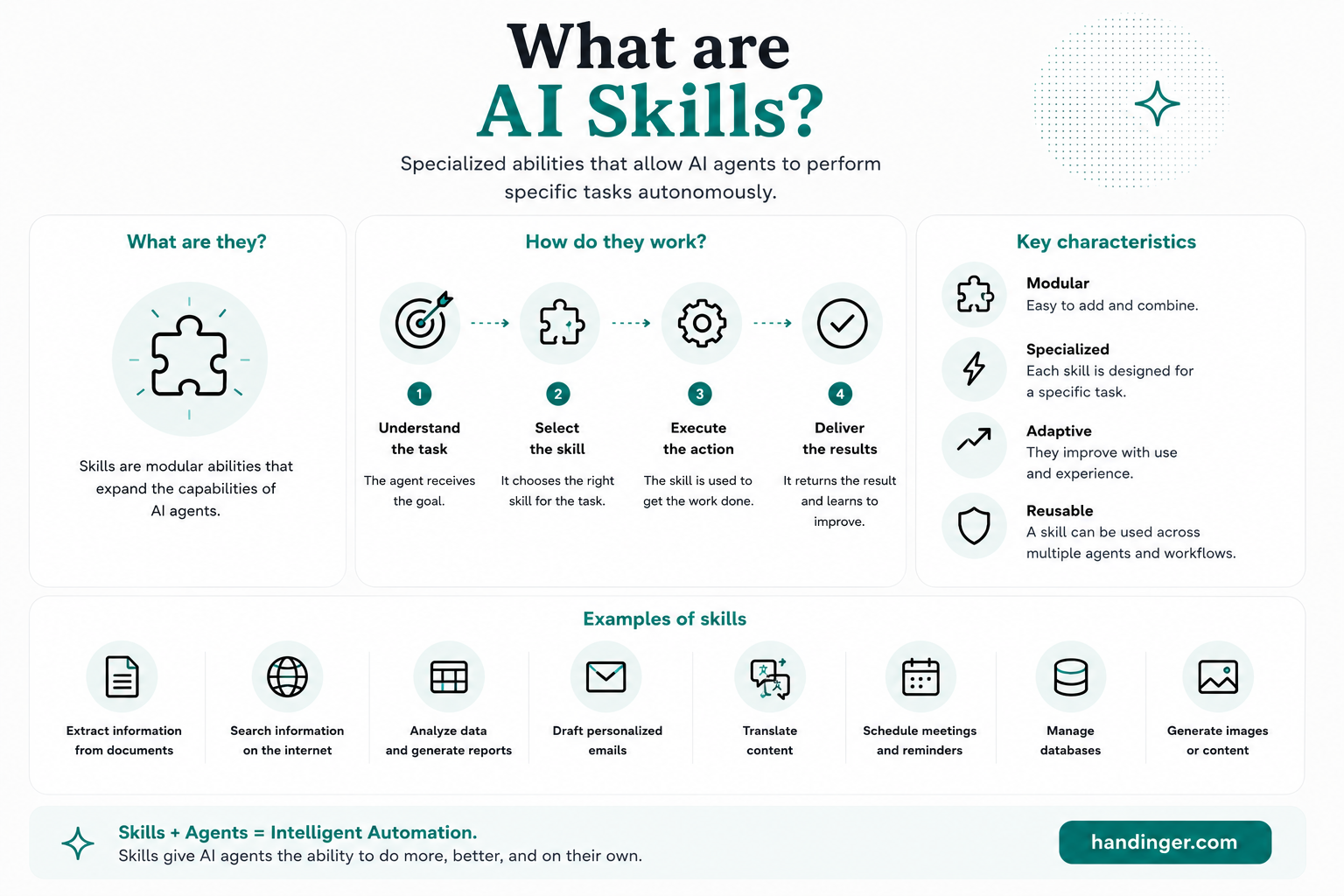
AI agent skills are portable, on-demand instruction packages that turn a general AI agent into a specialist. Here's what they are, how they work, and where they're already showing up.
What Are AI Agent Skills? A Practitioner's Guide
Last updated July 2026
Quick answer: an agent skill is a portable, on-demand instruction package, usually a markdown file plus optional scripts and templates, that an AI agent loads into its context only when a task actually calls for it. Instead of retraining a model or re-explaining your process every conversation, you write the process once and the agent picks it up automatically when it's relevant.
If you are mapping skills into a coordinated system, it helps to separate agentic AI from individual AI agents.
I built one of these earlier this week. Nothing fancy, just a packaged set of instructions for writing SEO content a specific way. It took maybe twenty minutes, and the model started using it correctly on the first real test. That's a strange thing to say about a piece of software you didn't have to write code for, and it's a big part of why this concept has spread from Anthropic's own products into VS Code, Microsoft's agent tooling, and a growing pile of independent GitHub repos in under a year.
What is an AI agent skill, exactly?
A skill is a folder with a SKILL.md file at minimum, sometimes bundled with scripts, templates, or reference docs. Inside the markdown file is a short description of what the skill does and when to use it, followed by the instructions the agent reads once it decides the skill applies. Anthropic's own engineering writeup frames it as giving an agent organizational knowledge, not new intelligence.
That distinction matters. A skill doesn't make the underlying model smarter. It gives an already-capable model a specific, repeatable way of doing one kind of task, the same way handing a new hire a runbook doesn't make them a better engineer, it just means they stop reinventing the deploy process from scratch every time.
How is a skill different from a prompt, a tool, or an MCP server?
This is the question I get asked most, and it's genuinely confusing because all four solve overlapping problems.
| Prompt | Tool / MCP | Agent skill | |
|---|---|---|---|
| What it provides | One-off instructions for this conversation | An action the agent can take, like an API call or file read | A reusable, on-demand process for doing a category of task |
| When it loads | Every time, whether relevant or not | Only when the agent decides to call it | Only when the agent decides the task matches |
| Reusable across sessions? | No, unless you paste it again | Yes | Yes |
| Typical content | A request | A function signature and permissions | Instructions, plus optional scripts and reference files |
A tool or an MCP server gives an agent something it can do. A skill gives it a way it should think through a category of task. They're not competitors. Most real setups use both: MCP for the actions, skills for the judgment calls about when and how to use them.
How do agent skills actually work?
The mechanism nearly every implementation uses is called progressive disclosure, and it solves a real, boring problem: context windows are finite, and you can't just dump every process document you own into every conversation.
- Metadata loads first, always. Just the skill's name and a one-line description, maybe a hundred tokens. This is how the agent knows the skill exists at all.
- Instructions load only when triggered. The full
SKILL.mdbody gets read once the agent decides the current task matches the description. This is where the actual workflow lives. - Bundled resources load only if needed. Extra reference files, scripts, or templates sit untouched on disk until the instructions specifically point to them.
The practical effect: you can have dozens of skills installed and the agent's context stays clean, because it's only pulling in the two or three that actually apply to what you asked for right now.
Where are agent skills showing up today?
Claude Skills is the implementation that started this, and it's still where nearly all the real search interest sits. Anthropic ships some built-in skills, like document creation and spreadsheet handling, and lets people author their own, distributed as plain folders or through a marketplace.
What's more interesting is how fast the format has spread beyond Anthropic's own products. VS Code supports agent skills for GitHub Copilot, working across the editor, the Copilot CLI, and the cloud agent, using essentially the same markdown-plus-frontmatter shape. Microsoft's Agent Framework has its own skills implementation for portable capability packages that agents discover and load on demand. Independent projects are showing up too: engineer Addy Osmani's open-source agent-skills repo is built around the parts of software engineering discipline that AI agents tend to skip, like writing a spec before the code.
That portability is the real story here. The format, a markdown file with frontmatter describing a workflow and a trigger condition, is turning into something closer to a shared convention than a single company's feature.
What are the benefits of using agent skills?
The obvious one is not repeating yourself. If you've ever pasted the same three-paragraph instruction block into a chat for the tenth time, that's the exact problem a skill solves. Write it once, and the agent applies it automatically whenever it's relevant.
The less obvious benefit is consistency at the organization level, not just the individual one. A skill can encode your team's specific way of doing something, like the exact report format you actually want, so the output matches your process instead of whatever the model would generate from a generic prompt.
What are the risks of using agent skills?
The one that actually matters: a skill can instruct an agent to do things, including running scripts and calling tools, so a malicious or badly written skill is a real attack surface. Anthropic's own documentation is blunt about this: only use skills from sources you trust, and audit anything you didn't write yourself, checking for network calls or file operations that don't match what the skill claims to do.
The more common failure, in my experience, isn't malice. It's confusion. A skill with vague or contradictory instructions gets followed faithfully and produces confidently wrong output, since the agent has no way to know the instructions themselves were the problem. The fix isn't clever engineering, it's the same discipline good technical writing always required. Be specific. Then test the thing on a case you don't already know the answer to.
Common misconceptions about agent skills
"A skill is just a longer prompt." Not quite. A prompt is re-sent every time, whether it's needed or not. A skill sits dormant until the agent's own judgment decides it applies, then loads on demand. That triggering behavior is the actual innovation, not the fact that it's markdown.
"Skills and MCP do the same job." They solve different halves of the same problem. MCP and tools generally give an agent an action it can take. A skill gives it a workflow for deciding when and how to use that action well. A skill with no tools is still useful; some of the most-cited ones are pure process documents like code review checklists.
Common questions
What are AI agent skills? Portable, reusable instruction packages that an AI agent loads automatically when a task matches what the skill is designed for, instead of a human re-explaining the process every time.
How are agent skills different from Claude Skills specifically? Claude Skills is Anthropic's specific implementation and the one that popularized the format. "Agent skills" is the broader, increasingly vendor-neutral term for the same underlying idea, now used by VS Code Copilot, Microsoft's Agent Framework, and various independent projects.
Are agent skills safe to use? Only as safe as their source. A skill can direct an agent to run code or call tools, so an untrusted or poorly audited skill is a genuine security risk, not just a quality one.
Do I need to know how to code to write one? No. A basic skill is just a markdown file with a short description and a set of instructions written in plain language. Bundled scripts are optional.
Can one skill call another? Not directly, but they can compose. A complex task can trigger several skills in sequence, each handling its own slice of the work, coordinated by the agent's own reasoning rather than by the skills calling each other explicitly.
Where is this going?
The pattern I'd watch is the same one that played out with containers a decade ago: a useful idea from one vendor turns into a shared file format once enough other tools adopt it, and then the format outlives whichever company invented it first. Skills are partway through that transition right now. Whether the ecosystem converges on one shared spec or fragments into several similar-but-incompatible versions across vendors is the open question.
For now, if you're building with AI agents regularly and keep re-explaining the same process, that's your signal to stop writing prompts and start writing a skill instead.
Related posts
Agentic AI vs. AI Agents: What's the Actual Difference?
Last updated July 2026 Quick answer: an AI agent is a single component that handles one task. Agentic AI is the broader system, the orchestration layer that coordinates multiple...
What Is an AI Agent? A Practitioner's Plain-English Definition
Last updated July 2026 Quick answer: an AI agent is software that perceives a goal, plans how to reach it, and takes action on its own using real tools instead of just guessing....
Where to read AI agents news
In 2024, most of us were still arguing about whether chatbots could write a decent email, and just two years later, my grandma is publishing iOS apps with the help of AI agents....