
AI sales prospecting: from leads to relevant conversations
Learn how to use AI at every stage of B2B sales prospecting: sourcing, qualification, research, outreach, and meeting preparation.
B2B sales prospecting is the process of identifying, evaluating and preparing to approach accounts or contacts with commercial potential. The difference with “capturing leads” is in the criteria: a lead can be a name on a list, a form, an imported contact or an account suggested by a tool; whereas a prospecting opportunity requires a sound reason to think that account deserves attention now, or at least a more serious review.
When AI is incorporated into the process, the improvement is not really in sending more messages, but in helping you prioritize and connect.
AI prospecting helps the salesperson identify and prioritize accounts with the highest potential, understand why they may be a fit, and prepare the right angle and message to open a relevant conversation.
In this guide we cover the sales prospecting workflow with AI:
- Lead sourcing: Find accounts that fit your Ideal Customer Profile (ICP) without turning the search into manual work or filling the CRM with duplicates.
- Lead qualification and data enrichment: detect leads with lower conversion potential before investing time in them.
- Account research: convert scattered signals into a sales hypothesis to know where to enter with the highest probability of response.
- Contact and follow-up (email outreach): Transforms account context into relevant emails and follow-ups to open commercial conversations.
- Meeting Preparation: Prepare each meeting with context, risks, objections and helpful questions, not the typical impromptu CRM review.
If you are not sure how to qualify leads, here we explain how to evaluate if an account deserves commercial attention. And if you are starting out in sales, here we explain what prospecting means and how it differs from sales prospecting (link pending)
AI does not replace commercial judgment nor guarantee responses, but a good tool can help you improve the quality of the approach message, and even improve the quality of the accounts.
Prospecting better is not getting more leads
A common problem in sales prospecting is confusing volume with advance. Having more leads can feel like progress because it increases visible activity: more registrations, more contacts, more tasks, more messages. But if those accounts don't fit, if the data is incomplete, or if no one knows why it was prioritized, volume quickly becomes operational cost.
Prospecting better involves separating four elements:
- Number of leads.
- Account quality.
- Signal quality.
- Commercial priority.
An account can have complete data and still not be a priority. Another may have little data, but a signal strong enough to investigate. And another may appear attractive in a tool without offering a clear reason to contact now.
If you want to go deeper into this, read why you don't need more leads, but better accounts.
How the sales prospecting workflow with AI works
Business prospecting workflow should not be measured only by "completed tasks." Finding accounts, completing data or composing messages are tasks; The important thing is what decision each phase produces.
A practical way to see that sequence is this:
| Phase | Question to answer | Result |
|---|---|---|
| Find candidate accounts | What companies could fit our ICP or use case? | Reviewable list with first batch of contacts. |
| Qualify the account | Is there enough data and signals to invest more time? | Account to be investigated or discarded (temporarily or permanently). |
| Investigate the prioritized ones | What is happening in that account and what sales hypothesis is reasonable? | Context, signals, inferences and possible sales objections. |
| Contact and follow up | What angle of conversation makes sense and should be reviewed before contact? | Draft or reviewable commercial action. |
| Prepare the meeting | If there is a response or meeting, what does the team need to know before moving forward? | Context prepared for a more useful conversation. |
AI can intervene in all of these phases, but its role changes depending on the decision: searching for information is not the same as summarizing context, comparing signals, or preparing a draft. The risk appears when the process jumps from “I found information” to “contact this person” without explaining why.
Find candidate accounts without creating sales noise
The first phase is usually understood as "capturing any company that seems interesting" but in reality it consists of generating reviewable candidates according to a minimum criterion of fit with your solution: sector, size, market, probable need, relationship with your ICP or any other condition that you explicitly use.
AI can help locate public information, extract data from sources, summarize pages, or group accounts by common signals. The result of this phase should be a list with candidate accounts, possible fit reasons, verified signals and missing data, not "500 new leads in an excel."
Qualify before investigating or contacting
Before spending time researching an account or preparing a message, it's a good idea to ask yourself if there is enough fit and information to move forward.
Data such as approximate size, activity, market, role of the contact person, signals of need for your product, technology used, recent event, hiring or organizational change appear here. Some will be verifiable facts; others will only allow an inference.
AI can help detect gaps, organize scattered information, summarize sources or suggest a provisional priority based on more advanced explicit fit criteria.
The result of this phase should be one of these decisions:
- Investigate the account further.
- Complete missing data and relevant context.
- Discard due to lack of fit or priority.
- Leave for review.
- Go to commercial research.
- Prepare contact directly if trust is sufficient.
If what you need is a method applied to a specific account, you have it in how to evaluate if an account deserves commercial attention.
Investigate the account to formulate a sales hypothesis
When an account passes the initial filter, the next step is to understand it enough to know how to connect with it and not send a generic message.
Account research must transform scattered data into a prudent sales hypothesis. It is not about knowing everything about the company, but rather distinguishing which facts are relevant, which signals suggest a possible need, which inferences are reasonable, and which doubts remain open.
For example, that a company is hiring a specific profile can be a verifiable fact if the offer exists. Whether that indicates a strategic priority is an inference. It may be reasonable, but it should not be treated as a certainty. The commercial message changes a lot if the team understands that difference.
AI can summarize sources, detect repeated themes, compare similar accounts or prepare an initial briefing. But business judgment is still necessary to decide what matters, what is noise, and what should not be stated in a contact.
The result of this phase should not be just a “company summary” but a business hypothesis with possible conversation angles, risks or objections, and the next recommended action.
Contact, follow up and prepare the next step
With a well-worked business hypothesis and research that provides context, AI can help turn all of this into a good contact draft and even propose variants based on the role of the people you contact. But delivery, tone, relevance, and compliance with boundaries need to be reviewed.
This phase is usually done poorly because AI is used to write an email that "sounds personalized" without really having a good signal behind it, without really understanding why your product/service now solves a problem for that company and they are interested in talking to you. This increases the risk of superficial messages and not connecting with the person receiving the contact, which reduces the likelihood of a response.
Tracking works the same. It shouldn't just be a insistence sequence. It should respond to what is known, what has been said, what remains pending and the next step that makes sense at all times.
If there is a response or meeting, the workflow does not end: it changes phase. From there, business readiness matters more than volume. The team needs context, likely objections, hypotheses, questions, and boundaries of what they know before entering the conversation.
Matrix to decide the next action in sales prospecting with AI
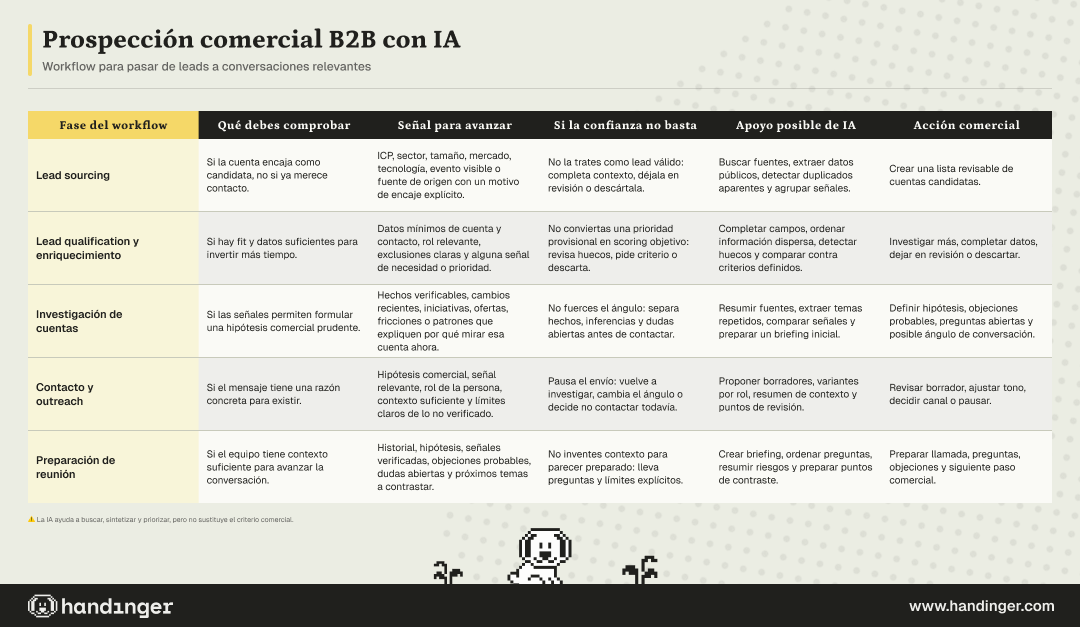
The matrix lowers the previous workflow to a practical question: Do we have enough context to move forward or are we about to force the next action? It does not work as a scoring or as a closed checklist; It serves to separate signal, confidence and decision before moving an account to the next phase.
| Workflow phase | What you should check | Minimum signal to advance | If trust is not enough | Possible AI support | Next commercial action |
|---|---|---|---|---|---|
| Lead sourcing | If the account fits as a candidate, not if it already deserves contact. | ICP, sector, size, market, technology, visible event or source of origin with an explicit fit reason. | Do not treat it as a valid lead: complete the context, leave it for review or discard it. | Search sources, extract public data, detect apparent duplicates, and cluster signals. | Create a reviewable list of candidate accounts. |
| Lead qualification and enrichment | If there is enough space and data to invest more time. | Minimum account and contact data, relevant role, clear exclusions and some sign of need or priority. | Do not convert a provisional priority into objective scoring: check gaps, ask for criteria or discard. | Complete fields, organize scattered information, detect gaps and compare against defined criteria. | Investigate further, complete data, leave for review or discard. |
| Account Research | If the signals allow us to formulate a prudent sales hypothesis. | Verifiable facts, recent changes, initiatives, offers, frictions or patterns that explain why to look at that account now. | Don't force the angle: separate facts, inferences and open doubts before contacting. | Summarize sources, extract repeated themes, compare signals and prepare an initial briefing. | Define hypotheses, probable objections, open questions and possible angle of conversation. |
| Contact and outreach | If the message has a specific reason for existing. | Business hypothesis, relevant signal, role of the person, sufficient context and clear limits of what is not verified. | Pause sending: investigate again, change the angle, or decide not to contact yet. | Propose drafts, variants by role, context summary and review points. | Check draft, adjust tone, decide channel or pause. |
| Meeting preparation | Whether the team has enough context to move the conversation forward. | History, hypotheses, verified signals, probable objections, open doubts and upcoming topics to contrast. | Don't invent context to appear prepared: bring explicit questions and boundaries. | Create briefing, order questions, summarize risks and prepare points of contrast. | Prepare call, questions, objections and next commercial step. |
Use it from left to right. If a row does not have a defensible signal or a reviewable inference, the action should not be “contact as soon as possible”, but rather review, complete, wait or discard. That is where AI adds the most value: not by deciding for the team, but by making more visible what is known, what is being interpreted and what is missing before acting.
Limits of sales prospecting with AI: data, automation and trust
As we have seen, AI can accelerate research, extraction, synthesis and preparation tasks. But it can also amplify errors if the data is bad, the criteria are weak, or you delegate sensitive decisions without reviewing them.
That is why it is advisable to talk about AI in prospecting with caution. Institutional frameworks such as the NIST AI Risk Management Framework, the public information of the European Commission on the AI Act or the OECD principles on AI responsible are not a sales methodology, but they point to a useful criterion here: if AI is involved in a business decision, the process must be explainable and reviewable.
In sales prospecting, the most important limits are these:
- Do not present inferences as facts.
- Do not use data without understanding source, purpose and limits.
- Do not promise reliable scoring if there are no criteria, validation and review.
- Do not assume that more automation equals better prospecting.
- Do not confuse personalization with mentioning any data found.
- Do not treat commercial contact as a task that can be sent en masse without responsibility.
AI doesn't fix poor data or weak criteria
If the input is poor, the AI can make the error faster. It may summarize the wrong source, fill out a field with unverified information, or suggest a priority that seems reasonable because it is well written.
In prospecting, this translates into poorly prioritized accounts, messages based on weak assumptions, or teams spending time on opportunities that should never have been advanced.
A practical way to reduce that risk is to require three elements before acting:
- Source or context of origin of the data.
- Criterion by which that data matters.
- Human review of the inference and the next action.
AI can support prioritization, but it should not hide judgment. If an account is listed as a priority, the team should be able to answer: “why this account, why now, and with what confidence?”
What to check now based on your prospecting problem
The next step depends on where the blockage is. Not all prospecting problems are fixed with more leads, more AI or more messages.
| If your problem is… | What you should check | Go to the guide... |
|---|---|---|
| You are not sure what prospecting means | Difference between prospecting, sales prospecting and customer acquisition | What does prospecting mean and how does it differ from sales prospecting (pending link) |
| You have many leads, but little quality | If the problem is volume, account quality, signals or prioritization | Why you don't need more leads, but better accounts |
| You don't know if a specific account deserves attention | Fit, signals, inferences, confidence and next action for that account | How to evaluate if an account deserves sales attention |
| You have signs, but no clear angle | Account research, business hypothesis and outreach preparation | Future destination of account research/outreach. Architecture slope. |
| There is already a response or meeting | Context, questions, likely objections and further preparation | Future business readiness destination. Architecture pending. |
How to put this sales prospecting workflow into practice with Handinger
If your team already understands the framework, the next step is to translate it into operation: candidate accounts, signals, inferences, confidence level, human review and next action.
Handinger can fit into that point as support to work the prospecting workflow: find and organize accounts, structure context, prepare research, help formulate commercial hypotheses and generate reviewable materials for outreach or subsequent preparation. The promise should not be “more meetings automatically,” but rather a clearer process for deciding where to put business effort and acting with better context.
The important thing is to maintain control over three layers:
- Business criteria: which account deserves attention and why.
- Traceability: what data or signal supports each inference.
- Review: what a person approves before contacting or moving forward.
If you want to try this approach in your own sales prospecting process, you can try Handinger for free. It helps you move from scattered lists to prioritized accounts with context: what signals are there, what inferences are reasonable, what needs to be reviewed, and what the next sales action should be.
The goal is to give you a more traceable workflow to better decide who to contact, why and with what message.
Related posts
Lead qualification: how to decide whether an account deserves sales attention
Lead qualification is the process of deciding whether a lead or account deserves sales attention based on its fit, available signals, context, data quality, and the level of...
Qualified leads: do you need more contacts or better accounts?
A qualified lead is an account or contact with enough fit, signals, and context to justify prioritized sales attention. When a team asks for “more leads,” it should answer a few...
Handinger made me faster at lead sourcing, which was apparently a problem
By 8:57 every morning, I was already at my desk, pretending the first coffee is still warm. The office lights had that particular white glow that makes everyone look less healthy...