
Lead qualification: how to decide whether an account deserves sales attention
Evaluate whether a B2B account deserves sales attention based on fit, signals, data, inferences, confidence, and next action.
Lead qualification is the process of deciding whether a lead or account deserves sales attention based on its fit, available signals, context, data quality, and the level of confidence with which you can act.
An account deserves attention when what you know about it, including fit, verifiable facts, and signals, supports a proportionate and reviewable next sales action: research, contact, review, discard, or prioritize. Opening an email, appearing in a list, or having a favorable CRM score is not enough.
This article does not propose a universal score or a way to predict which accounts will buy. It gives you a method for looking at one account, separating data from inferences, and deciding what level of effort makes sense without overreacting to weak signals.
The question is: what sales attention does this account deserve now, and what is missing to decide better? Sometimes the answer is to contact. Sometimes it is to research first. And sometimes it is to review data, discard temporarily, or leave the account outside priority.
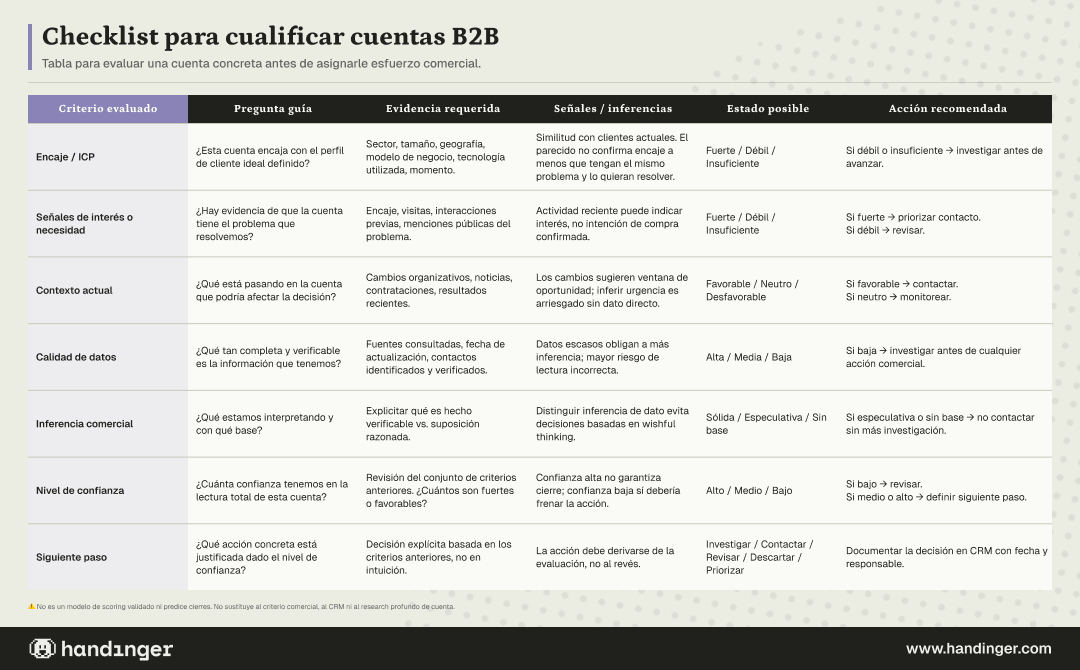
MQL, SQL, BANT, and lead scoring can guide the decision, but they do not close it by themselves. Qualification becomes more useful when it leaves a trace of why an account moves to the next step: what fits, what signal exists, what is being inferred, and how much confidence there is.
This diagnosis belongs to the broader system of finding, qualifying, researching, contacting, and preparing the next step. Read the complete AI sales prospecting framework.
What lead qualification should produce
In this article, qualifying a lead means deciding what sales attention a specific account deserves right now with the information available.
A lead or account is an assessable record: it may contain company data, contact data, activity, source, sector, size, ICP fit, or any other useful signal. A sales opportunity is a later step: it requires more context, a defensible hypothesis, and enough reasons to invest follow-up. Initial qualification sits between the two. It prevents every record from being treated the same and prevents one isolated signal from being confused with a real opportunity.
A good qualification should produce an operational decision:
- Research, if the account looks like a fit but lacks enough context for action.
- Contact, if there is enough fit, a defensible signal, and reasonable confidence in the data.
- Review, if critical data is missing, inconsistent, or the inference is too weak.
- Discard, if fit is poor or the available information does not justify attention now.
- Prioritize, if several accounts compete for the same sales time and this one combines better fit, signals, and confidence.
This nuance matters because an account can show activity and still be a poor fit. It can also match the ICP and still lack enough basis for direct outreach. Useful qualification does not hide that tension; it turns it into a proportional, reviewable decision.
Why MQL, BANT, or scoring are not enough
MQL, SQL, BANT, and lead scoring can help organize a list, but they should not decide by themselves what sales attention an account deserves. Their value is in turning scattered signals into an initial reading; their limit appears when that reading is treated as objective truth.
An MQL usually means marketing believes the lead meets internal criteria. An SQL can indicate that sales sees it as closer to a commercial conversation. BANT forces a review of budget, authority, need, and timing. A score summarizes activity, declared data, or prioritization rules. All of that can help, but it leaves important questions open: does the account fit the ICP, is the signal recent and relevant, are the data reliable, what is being inferred, and with what confidence?
Activity, for example, is not the same as fit. An account can download a resource, visit several pages, or reply to a campaign and still belong outside the segment you serve well. The opposite can also happen: a good-fit account may not yet show enough signals to justify direct contact. If the method only rewards movement, it confuses interest with sales priority.
MQL, SQL, BANT, and scoring are inputs, not verdicts. They help organize information, but the sales decision needs to separate fit, verifiable facts, signals, inferences, and confidence before acting.
The risk of relying too much on a label is that the conversation closes too early. To decide well, qualification must show the reasoning behind the label.
Fit, signals, data, inference, and confidence
The central criterion is to start with verifiable data, read signals in context, formulate reviewable inferences, and decide according to confidence.
The chain is:
verifiable fact or data → signal → inference → confidence → decision
The order matters. If you jump from a signal to action without checking fit, source, date, or consistency, the decision feels fast but fragile. If you require absolute certainty before doing anything, qualification becomes useless. The practical point is between the two: act when the information supports a proportional decision and review when it does not.
What you know: fit and verifiable data
First separate what you know from what you assume. Fit answers a basic question: does this account at least minimally match the kind of customer you can help?
That fit does not need to become a full ICP template here, but it should review minimum criteria: segment, size, industry, geography, likely use case, and buyer profile if known. If the account fails a critical criterion, activity should not automatically compensate for it.
Then comes the factual base: what data you have, where it came from, when it was updated, and whether it is complete, consistent, and not duplicated.
- With enough fit and clear data, the account can move to signal interpretation.
- With doubtful fit and incomplete data, review is usually needed.
- With poor fit, activity should not be enough to prioritize.
Sales attention is limited, and it should first go to accounts whose fit can be defended with data, not only intuition.
What you interpret: signals and reviewable inferences
A signal is an interpretable clue, not proof. It can suggest interest, need, urgency, or context, but it needs a prudent reading before becoming a sales action.
For example, if an account visits several pages related to a specific problem, that may indicate interest. It may also be general research, curiosity from a non-decision-maker, or activity that does not represent a commercial opportunity. The inference should not be “they want to buy,” but “they may be exploring this problem; we need to check ICP fit and whether there is enough context to contact.”
We observe X, infer Y, and still need Z to act with more confidence.
That sentence avoids two common errors: ignoring useful signals and treating them as conclusive proof. The signal orients, the inference proposes, and confidence decides how far to move.
How much confidence supports the decision
Confidence does not measure whether an account will buy. It helps determine what sales attention to dedicate and what next action to take.
Confidence can be strong when fit is clear, data is recent and consistent, the signal relates to a relevant problem, and the inference can be explained without forcing it. In that case, contact, priority research, or the next planned step may make sense.
Confidence is weak when some element fails: fit is unclear, the signal is ambiguous, the source is unreliable, or context is missing. The prudent decision is usually to review, complete information, or research lightly before assigning sales effort.
Confidence is insufficient when critical data is missing, there are inconsistencies or duplicates, information is old, or the inference is too speculative. Not acting yet is also a valid decision. Reviewing or temporarily discarding can be better than contacting because a label or score pushes you to do it.
Matrix for deciding what sales attention an account deserves
This matrix applies the criterion to one account. It does not calculate close probability, replace sales judgment, or turn a weak signal into a real opportunity. Its function is to organize what you know, what you interpret, what is missing, and which action you can defend.
| Criterion | Guiding question | Evidence to review | Prudent reading | Action it supports |
|---|---|---|---|---|
| Fit / ICP | Does the account match the kind of customer you can help? | Segment, size, industry, geography, likely use case, and buyer if known. | If basic fit is weak, activity carries little weight. Status: strong, weak, or insufficient. | Prioritize, research, or temporarily discard. |
| Verifiable data | What do you know about the account and where does it come from? | Source, date, completeness, consistency, duplicates, and critical fields. | Old, incomplete, or contradictory data reduces confidence in the whole evaluation. | Move forward if reliable; review if not. |
| Signals | Are there relevant signs of interest, need, or context? | Recent activity, content interaction, public changes, source of entry, or declared signals. | A signal suggests; it does not prove buying intent or urgency. | Research or contact only if fit and data support it. |
| Context | Does the signal make sense in the account’s current situation? | Timing, contact role, possible problem, recent change, or relation to a defensible need. | Without context, a signal can be noise or curiosity. | Research more, review, or wait for better data. |
| Sales inference | What conclusion are you drawing and what remains to verify? | Sentence such as “we observe X, infer Y, and still need Z.” | If the inference cannot be stated clearly, it is probably too speculative. | Review, research, or prepare cautious contact. |
| Confidence and next action | Does the information support acting now? | Fit, data quality, signal strength, context, and inference. | The decision should be proportional to confidence, not to the wish to move the account. | Research, contact, review, discard, or prioritize. |
The final row forces the reasoning to close. A good-fit account with a reasonable signal may deserve priority research even if it is not yet time to contact. An active account with poor data and doubtful fit may deserve review or temporary discard, not more sales effort.
Use it without turning it into a score
Start with facts, not opinions: what company it is, which segment it belongs to, how large it is, which data is recent, which source supports it, and which concrete signals exist. Then write the inference in a reviewable sentence: “we observe X, infer Y, and still need Z.” If that sentence sounds forced, the matrix has already answered: there is not enough basis to act confidently.
Then assign a qualitative status:
- Strong: defensible fit, clear data, relevant signal, and prudent inference.
- Weak: part of the reasoning exists, but context is missing, the signal is ambiguous, or the data is not fully reliable.
- Insufficient: critical data is missing, contradictions exist, or the inference depends more on assumption than evidence.
The matrix should create traceability, not a final grade. The point is not to say “this account has an 82,” but to explain why you research, contact, review, discard, or prioritize it.
If there is not enough data
If critical data is missing or confidence is low, the right decision is probably to review before contacting.
Do not move to direct sales action when:
- The company only appears to fit, or minimum ICP criteria are missing.
- The data source is unclear, outdated, or contradictory.
- A signal exists but cannot be connected to a concrete need.
- The inference assumes intent, urgency, or budget without support.
- The account appears prioritized only because a label or score pushes it.
Reviewing does not block prospecting. It avoids spending sales attention on a decision that cannot yet be defended. If this happens repeatedly, the issue is no longer only account-by-account qualification; it may be an input-quality or process problem. For that layer, read how to diagnose whether you need more contacts, better accounts, or clearer prioritization.
What to do after evaluating the account
Qualification ends when you assign an action proportional to what you know, what you infer, and the confidence behind the evaluation.
| Action | When to use it | Prudence signal | What it does not imply |
|---|---|---|---|
| Research | Fit looks promising and there is a useful signal, but context is missing. | Do not confuse research with immediate contact. | It does not yet open a full sales hypothesis or outreach sequence. |
| Contact | Fit, data, signal, and inference are strong enough for direct action. | The reason for contact must be explainable without forcing the signal. | It does not guarantee reply, opportunity, or purchase. |
| Review | Critical data is missing, inconsistent, or the inference is weak. | Review is valid when it prevents action on noise. | It does not require rebuilding the CRM. |
| Discard | Fit is poor or the signal does not justify attention now. | Discard can be temporary if data or context changes. | It does not mean the company is bad. |
| Prioritize | Several accounts compete for time and this one combines better fit, signals, data, and confidence. | Priority should not hide critical doubts. | It does not predict close or replace sales review. |
The weaker the confidence, the less irreversible the action should be. With low confidence, reviewing, waiting, or temporarily discarding is usually wiser than contacting. With reasonable confidence, researching or contacting can make sense depending on what is missing.
Prioritize a shortlist without fake scoring
When you have several accounts in front of you, you do not need to turn the matrix into a score. You need to apply the same criteria to all of them and order by action and confidence.
- Evaluate each account with the same matrix: fit, data, signals, context, inference, and confidence.
- Group by recommended action: contact, research, review, discard, or wait for more data.
- Within each group, compare the quality of the reasoning, not only the number of signals.
- Break ties by asking which account combines better fit, relevant signal, reliable data, and clear next step.
- Write down the reason for priority so another person can understand it.
Two accounts with similar activity may deserve different decisions. Account A may have ICP fit, recent data, and a signal that supports priority research. Account B may have similar activity but poor fit, incomplete data, and a speculative inference. Activity without fit and confidence should not automatically become sales attention.
Limits and next steps
This method solves one decision: what sales attention an account or lead deserves with the information available. It does not solve all prospecting, design an advanced scoring system, or guarantee that an account will reply, become an opportunity, or close.
Keep these limits visible:
- It helps decide an initial action: research, contact, review, discard, or prioritize.
- It does not predict commercial outcomes.
- It does not fix a data-quality problem by itself.
- It does not replace account research.
- It does not turn AI or automation into a verdict.
If your problem is earlier, use this guide to diagnose the quality and type of leads your team is receiving. If you need to understand where this decision fits in the whole process, place qualification inside the AI sales prospecting workflow.
In short: an account deserves sales attention when fit, signals, data, and confidence support a proportional action. If you cannot explain why you are researching, contacting, reviewing, discarding, or prioritizing, you do not yet have useful qualification; you have a label.
Related posts
Qualified leads: do you need more contacts or better accounts?
A qualified lead is an account or contact with enough fit, signals, and context to justify prioritized sales attention. When a team asks for “more leads,” it should answer a few...
AI sales prospecting: from leads to relevant conversations
B2B sales prospecting is the process of identifying, evaluating and preparing to approach accounts or contacts with commercial potential. The difference with “capturing leads” is...
Handinger made me faster at lead sourcing, which was apparently a problem
By 8:57 every morning, I was already at my desk, pretending the first coffee is still warm. The office lights had that particular white glow that makes everyone look less healthy...