
Qualified leads: do you need more contacts or better accounts?
Diagnose whether your B2B team needs more leads, better accounts, clearer prioritization, or improved sales execution.
A qualified lead is an account or contact with enough fit, signals, and context to justify prioritized sales attention.
When a team asks for “more leads,” it should answer a few questions before filling the pipeline again. The problem may genuinely be insufficient volume, but it may also be poor-fit accounts, weak signals, incomplete data, or priorities that marketing, sales, and leadership interpret differently.
This especially affects B2B teams facing pipeline pressure, low response rates, or CRM noise. More acquisition can help when market coverage is insufficient. But if account quality, prioritization, or downstream execution is the real problem, more contacts may add noise and operating cost before they add clarity.
Before investing more time, budget, or automation, separate four diagnoses: you need more contacts, better accounts, better prioritization, or a review of what happens after a lead is selected.
This diagnosis belongs to the broader system of finding, qualifying, researching, and contacting accounts. Read the complete AI sales prospecting framework.
What is a qualified lead, and what decision does it support?
A qualified lead is not simply someone who entered a database. Qualification means placing the account in enough context to decide whether to contact, prioritize, nurture, or discard it relative to other options.
An account may have potential without being ready to buy, requesting a demo, or confirming budget. It can still deserve attention when it matches the kind of company you can serve, shows reasonable signals, and provides enough context for a meaningful sales action.
Lead, MQL, SQL, and opportunity: useful distinctions
MQL and SQL labels can help when marketing and sales share criteria, but they are not universal standards. Every company defines stages around its sales cycle, sources, process, and risk tolerance.
| Term | What it means in practice | Diagnostic limit |
|---|---|---|
| Lead | A contact or account that enters the sales radar. | It may lack fit, meaningful signals, or priority. |
| Qualified lead | An account or contact with enough fit, signals, and context to justify sales attention. | It does not guarantee a sale, reply, or pipeline progress. |
| MQL | A lead showing marketing engagement according to agreed criteria. | It does not automatically mean sales should prioritize it. |
| SQL | A lead that sales can review or work with greater priority under shared criteria. | It depends on internal agreement and is not always an opportunity. |
| Opportunity | A possible commercial case with a conversation, need, or more concrete fit. | It follows further validation of the context. |
| Disqualified lead | An account that does not deserve attention now because of poor fit, timing, signals, or data. | New information can change the decision; it is not always permanent. |
This prevents teams from debating labels when the actual issue is criteria. If MQL, SQL, and “qualified lead” mean different things to different people, the team may believe it needs volume when it really needs better entry criteria and prioritization.
The next question is what is failing: are there too few ICP contacts, weak accounts entering the pipeline, no shared criteria, or poor execution after selection?
Do you need more contacts, better accounts, or better prioritization?
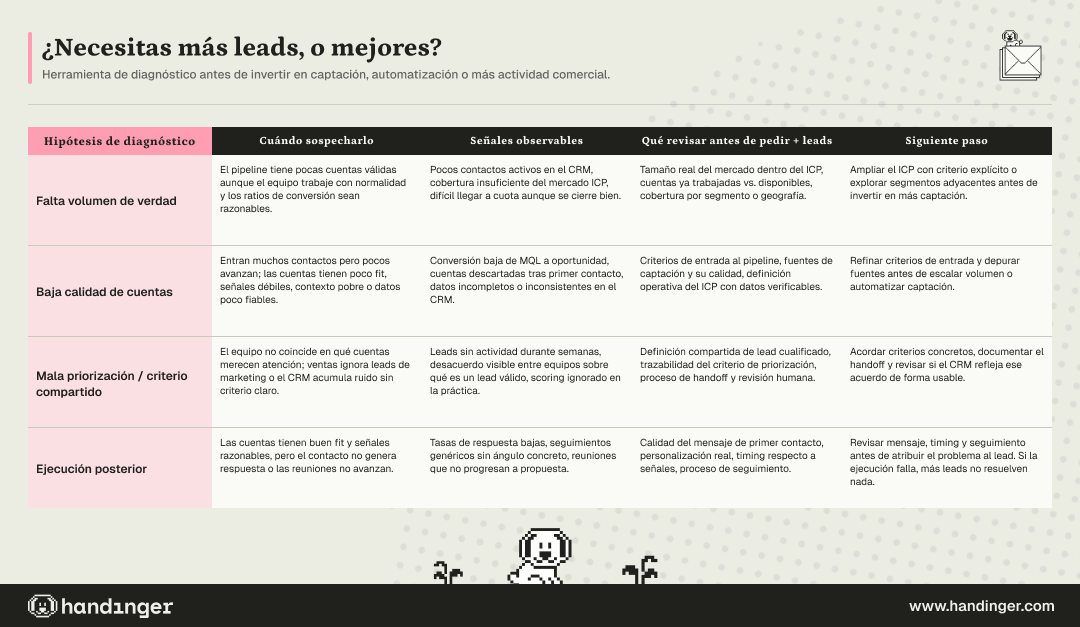
“We need more leads” can describe four different problems: low volume, poor account quality, weak prioritization, or downstream execution that fails to make use of reasonable accounts.
Use this matrix to organize the discussion before investing more in acquisition, AI, or sales activity.
| Diagnosis | When to suspect it | Observable signals | What to review before requesting more leads | Next step |
|---|---|---|---|---|
| Genuine lack of volume | The ICP is reasonably clear and the team is not working obviously poor-fit accounts, but the available sample is too small to sustain sales work. | Few target-market accounts, repeated contacts, uncovered segments, or weeks with almost nothing new for sales to review. | Market coverage, whether sources reach the right segment, and whether filters exclude valid accounts. | Expand coverage within the ICP without relaxing the criteria until every contact becomes a lead. |
| Poor account quality | Volume exists, but many accounts do not match the customers you can serve or arrive with signals too weak to justify attention. | Out-of-segment companies, irrelevant roles, incomplete data, generic signals, and leads quickly rejected by sales. | ICP definition, sources, minimum required data, and the signals needed to move an account into sales review. | Refine entry criteria and separate accounts worth researching from CRM noise. |
| Weak prioritization or shared criteria | Reasonable accounts enter, but the team disagrees on which deserve attention first and why. | Marketing values leads sales ignores, people prioritize differently, and the CRM does not explain priority. | Who defines priority, what evidence is required, where the reasoning is recorded, and how sales feedback improves it. | Establish common, traceable criteria before automating prioritization or adding volume. |
| Downstream execution | Accounts have fit and reasonable signals but fail to advance because of how they are researched, contacted, prepared, or followed up. | Generic messages, little account context, unchecked timing, irregular follow-up, or unsuitable contacts. | Whether message, timing, contact, follow-up, and preparation match the quality of the account. | Review execution before blaming lead quality, buying more acquisition, or rejecting the segment. |
Several causes can coexist, but prioritize one hypothesis. Trying to fix volume, quality, prioritization, and execution at once often creates more fields, lists, and activity without better judgment.
Review a recent sample: rejected leads, sales rejection reasons, accounts genuinely inside the ICP, and actions performed on the best-fit accounts. That evidence should show which hypothesis deserves attention first.
If the diagnosis points to poor account quality, see how to evaluate whether an account deserves sales attention.
Why a qualified lead reduces uncertainty but does not guarantee sales
Qualification turns scattered data, signals, and context into a hypothesis for sales attention. It improves the decision compared with working contacts that lack fit, context, or a clear reason for priority; it does not create a sale by itself.
| Element | What it contributes | Limit |
|---|---|---|
| Fit | Shows whether the account resembles the customers you can serve. | It does not prove interest, urgency, or buying power. |
| Signals | Provide observable indications of need, change, or opportunity. | A signal requires interpretation and is not buying intent. |
| Context | Explains why the account may deserve a specific action now. | Without context, a real signal can produce a generic message. |
| Reliable data | Reduces identification, segmentation, and follow-up errors. | Data may still be incomplete, outdated, or misinterpreted. |
| Human review | Challenges the inference before allocating sales time or automating decisions. | Without shared criteria, review becomes subjective and hard to trace. |
See how to evaluate why one account deserves more attention than another.
Symptoms of poorly qualified leads
The main symptom is not only low final conversion but sales activity without clarity. Teams review lists, research accounts, send messages, and update stages without being able to explain why one account deserved priority over another.
Common patterns include:
- Accounts without enough fit. Companies fall outside the ICP or belong to segments the team cannot serve well.
- Poor or unreliable data. Key information is missing, roles are outdated, companies are duplicated, or signals lack a clear source.
- Weak or misread signals. A download, visit, job opening, or technology change is treated as direct purchase intent.
- CRM noise and opaque priorities. Records are plentiful, but few explain fit, signals, context, and evidence.
- Sales rejects leads without learning. Leadership sees volume, sales sees low utility, and nobody closes the feedback loop.
- Uneven research. Some accounts receive detailed review while others are handled with minimal information.
- Generic messages. Leads without context produce templates, assumptions, and superficial personalization.
These symptoms do not prove every lead is bad. They show that the intake process does not generate enough confidence to allocate attention consistently.
When lead quality is not the problem
“We need better leads” is not a universal explanation. Account quality may be reasonable while volume is insufficient, the market is narrower than expected, the message does not resonate, timing is poor, follow-up is irregular, or the offer is not right for the segment.
A real volume problem appears when the target market is defined, reviewed accounts are generally within fit, and the team still has too few options. It can also appear when only part of a segment is covered or relevant contacts are missing inside suitable accounts.
Diagnosing volume still requires evidence: how many ICP accounts have been identified, how much of the market is covered, and how many were rejected for what reason. Without that review, “we lack leads” is a feeling rather than a diagnosis.
What to do after the diagnosis
- If volume is genuinely low, expand coverage within the ICP before tightening filters further.
- If account quality is poor, review sources, minimum criteria, signals, and intake data.
- If prioritization fails, agree on the evidence that moves an account up or down and record the reason.
- If downstream execution fails, review the message, timing, selected contact, preparation, and follow-up before blaming the lead.
Handinger can turn these criteria into an operational prospecting workflow. It connects to your tools, reviews accounts and contacts, enriches information, interprets signals, applies shared criteria, and returns explainable prioritization so the team does not work blind lists.
The value is not only task automation. Every account arrives with a reason: why it fits, which signals matter, what information is missing, the confidence level, and the recommended next sales action.
If your team has volume but struggles to decide which leads deserve attention, Handinger can turn lead qualification into an operational workflow with less CRM noise, more traceability, and better decisions before sales time is invested.
The next step is to create a free Handinger account and move from a general diagnosis to concrete decisions: which accounts to research, review, or discard. If you still need an account-by-account method, see how to evaluate whether an account deserves sales attention.
Related posts
Lead qualification: how to decide whether an account deserves sales attention
Lead qualification is the process of deciding whether a lead or account deserves sales attention based on its fit, available signals, context, data quality, and the level of...
AI sales prospecting: from leads to relevant conversations
B2B sales prospecting is the process of identifying, evaluating and preparing to approach accounts or contacts with commercial potential. The difference with “capturing leads” is...
Handinger made me faster at lead sourcing, which was apparently a problem
By 8:57 every morning, I was already at my desk, pretending the first coffee is still warm. The office lights had that particular white glow that makes everyone look less healthy...